
Main Content
What Is a Graduation Tassel?

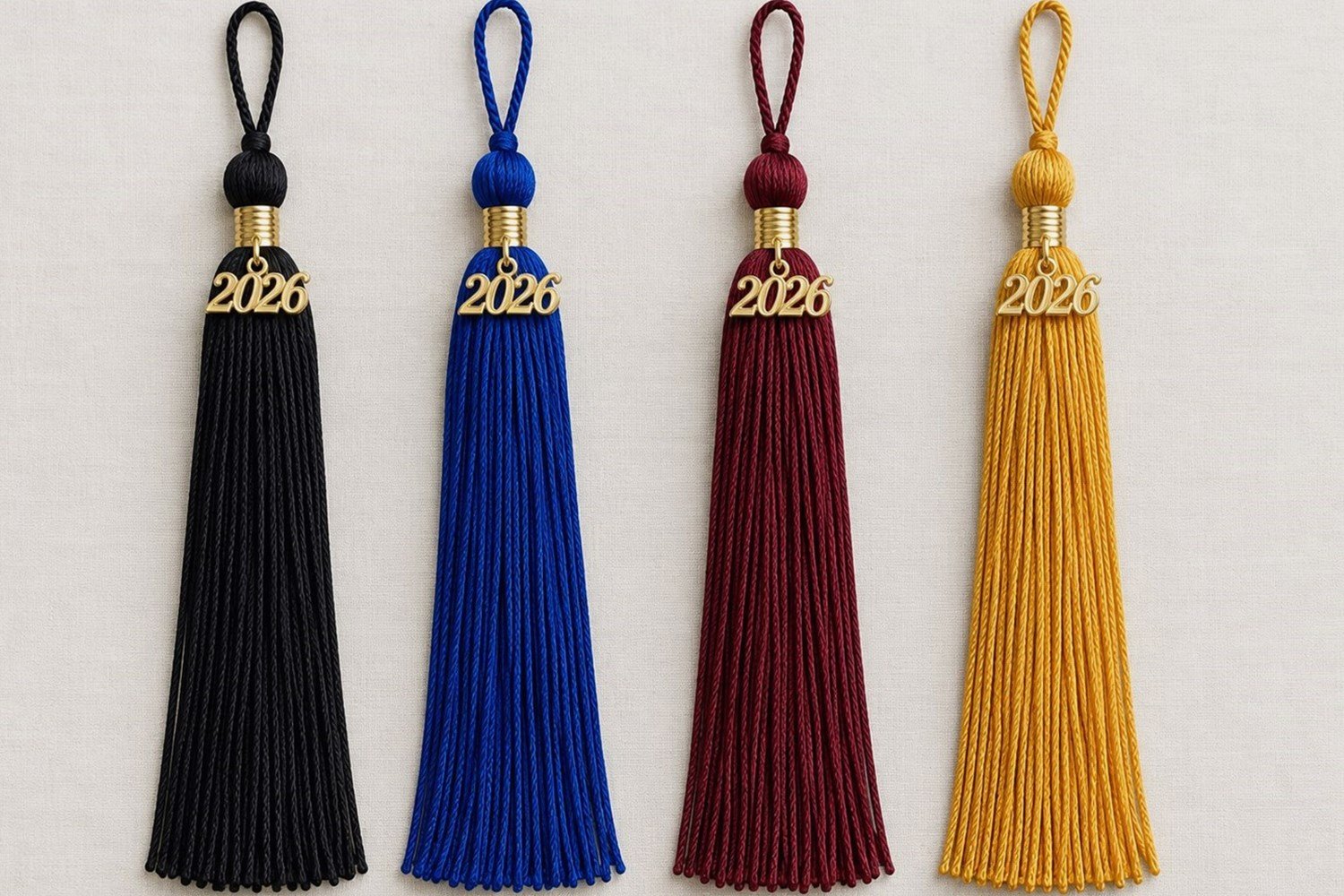
A graduation tassel is an academic-regalia accessory attached to a graduation cap, typically made from a hanging group of strands connected to a cord or loop. It can serve a ceremonial, decorative, symbolic, and identifying role at high-school ceremonies, college ceremonies, university commencements, academic programs, and special recognition events. Institutions do not all use the same tassel form.
| Term | Meaning |
|---|---|
| Graduation tassel | Hanging ornament attached to an academic cap |
| Mortarboard | Square academic cap commonly used at graduation |
| Academic regalia | Ceremonial academic clothing and accessories |
| Commencement | Graduation ceremony |
| Year charm | Small component identifying a graduation year |
Graduation tassels are a specific academic application within the broader family explained in What Are Tassels?. Their cap attachment, ceremony role, and institutional identifiers separate them from tassels used on furnishings, bookmarks, keys, or fashion accessories.
What Are the Parts of a Graduation Tassel?
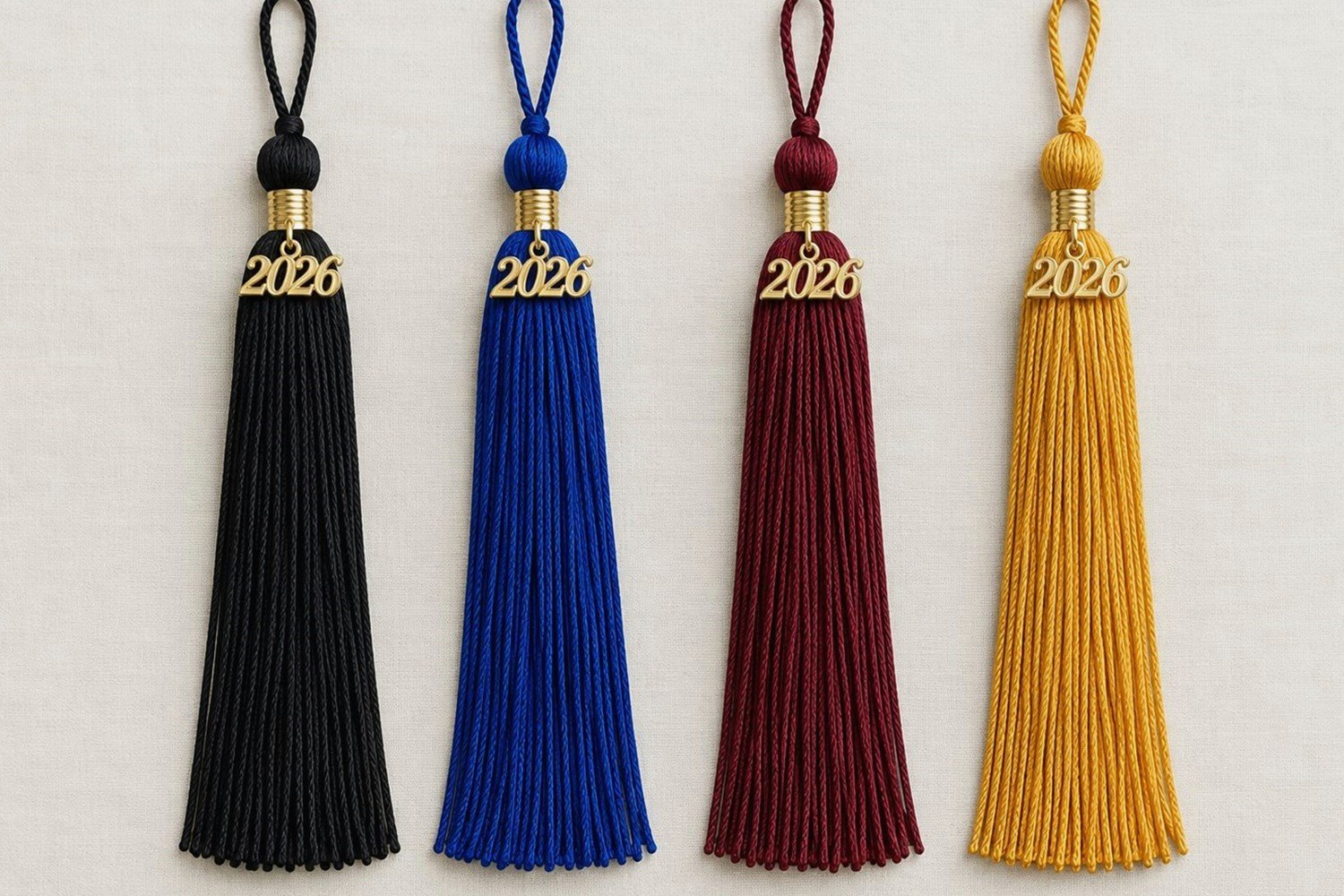
Graduation tassel construction varies, but a product commonly combines a loop, cord, head or binding, hanging skirt or strands, and sometimes a charm or attachment ring. Each part helps create the visual form or connect the tassel with the cap. Not every tassel includes every component in exactly the same form.
| Part | Function | Possible Variation |
|---|---|---|
| Loop | Attaches to cap button | Length and construction |
| Cord | Suspends tassel | Length, color, material |
| Head or binding | Holds strands together | Shape and construction |
| Skirt or strands | Creates the hanging body | Length, fullness, material |
| Charm | Adds an identifying detail | Year, logo, symbol, finish |
| Ring | Connects charm where used | Size and finish |
The loop generally connects at the cap’s center button, although cap construction and institutional directions should be confirmed. A charm can be integrated into the cord or attached as an additional element. The product specification should name each required component rather than assuming a reference image shows every detail.
What Is a Graduation Tassel Used For?

Graduation tassels complete the graduation cap and can express ceremony tradition, academic identity, school identity, graduation year, or a keepsake connection. Their importance is contextual: an institution may use a color for a college or program, attach a year charm, or simply use a coordinated cap-and-gown direction.
| Purpose | Example |
|---|---|
| Academic regalia | Completes the cap as ceremonial dress |
| Ceremony tradition | May be moved according to official direction |
| Academic identification | Can reference school, degree, or program |
| School identity | Can coordinate with official colors |
| Graduation year | Charm can identify the graduating class |
| Keepsake | Can remain as a commencement memento |
Meaning should not be inferred from the tassel alone. The school, ceremony materials, and official regalia instructions explain the intended use more reliably than a generic product description.
Symbolism, Movement, and Tassel Side

Graduation tassels are widely associated with completion, academic achievement, transition, identity, and institutional tradition. Moving the tassel is a recognized commencement practice that can mark a ceremonial transition after graduates are recognized or degrees are conferred. The exact procedure varies by institution, degree level, cap type, and ceremony.
| Symbolic role | Typical interpretation |
|---|---|
| Completion | Completion of a course of study |
| Transition | Ceremonial movement from candidate to graduate |
| Identity | School, degree, or discipline association |
| Recognition | Graduation year or special program |
| Tradition | Participation in academic ceremony |
Wearing sequence: follow institution instructions before the ceremony; wait for official direction during the ceremony; move the tassel only if instructed; and wear it after the ceremony according to local tradition. Right-to-left movement is common in many U.S. ceremonies, especially for bachelor’s contexts, but it is not a universal academic rule. Master’s, doctoral, and international ceremonies may differ.
| Situation | General guidance |
|---|---|
| High school | Check school ceremony instructions |
| Bachelor’s | Right-to-left is common in many U.S. ceremonies; confirm locally |
| Master’s | Follow institution instructions |
| Doctoral | Follow institution and regalia requirements |
| International ceremony | Follow local academic tradition |
What Do Graduation Tassel Colors Mean?

Graduation tassel colors can represent an academic discipline, college, degree, institutional identity, school color, program, or special recognition, depending on the institution. Academic color traditions exist, but the chosen tassel color system is not identical at every school. Official institutional requirements always take priority over general color references.
Common academic color associations, not universal rules:
| Color | Common association or traditional reference |
|---|---|
| White | Arts, letters, or humanities |
| Light blue | Education |
| Orange | Engineering |
| Brown | Fine arts |
| Pink | Music |
| Purple | Law |
| Golden yellow | Science |
One university may use discipline colors, another may use college colors, and another may use university colors for undergraduates. A custom ceremony can use a project-specific direction. See Tassel Colors for broad color-selection context, but confirm the final graduation choice with the institution.
Materials, Size, and Graduation Tassel Types

Graduation tassels can use different yarns, cords, metallic accents, and charms, and there is no single universal tassel length or material. Material influences sheen, drape, visible fullness, color appearance, and the product’s relationship with the cap and gown. A supplier dimension or material should be treated as a project specification, not as an academic standard.
| Aspect | What to define |
|---|---|
| Material | Required visual appearance, sheen, and texture |
| Overall length | Named start and end points |
| Cord length | Measurement method and cap relationship |
| Loop | Cap attachment requirement |
| Head and skirt | Required shape, fullness, and finish |
| Charm | Whether it is required and its style |
Common graduation formats include standard cap tassels, tassels with year charms, school-color tassels, single-color designs, two-color designs, multi-color designs, and personalized or event-specific variations. The Tassel Size and Length article explains why a clear measurement method matters.
Single-Color, Multi-Color, and Year-Charm Tassels
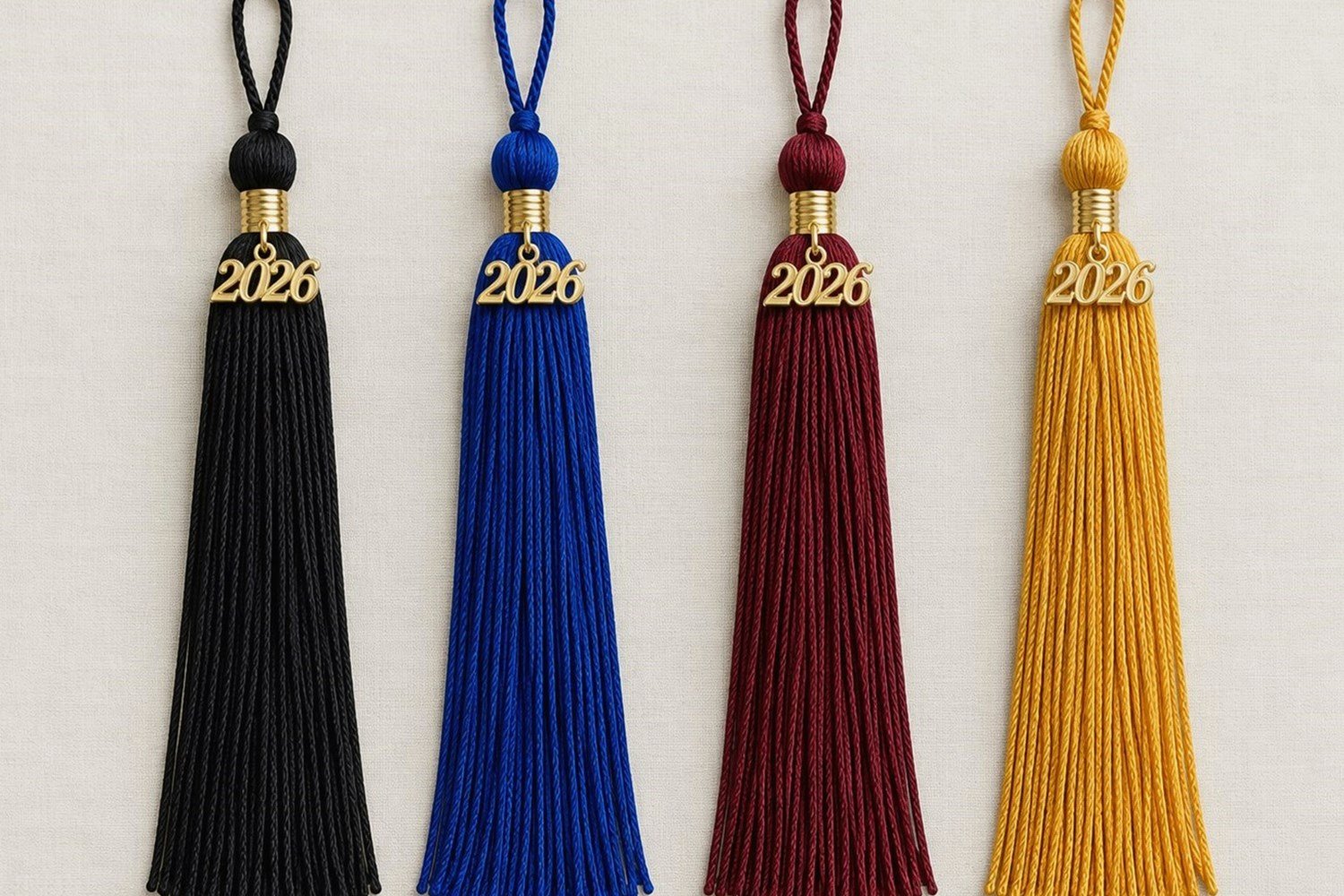
Single-color graduation tassels use one defined color, while two-color and multi-color tassels combine colors to express school, program, event, or custom identity. Not every institution allows or uses multi-color designs, so buyers should define the color count, distribution, cord color, and charm finish in the approved direction.
| Design | Color structure | Important specification |
|---|---|---|
| Single color | One color | Exact shade and material appearance |
| Two color | Two colors | Distribution and relationship |
| Three or more colors | Multiple colors | Position and sequence |
A graduation year charm is a small decorative component that identifies a graduating class. It may be metallic, colored, number-shaped, flat, or decorative. A standard year charm identifies the class year; a custom charm can represent a logo, organization, program symbol, or approved artwork.
| Charm type | Purpose | Customization |
|---|---|---|
| Year charm | Identifies class year | Year and finish |
| Logo charm | Represents organization | Artwork and finish |
| Symbol charm | Represents program or event | Shape and design |
Graduation Tassels Compared With Other Regalia

Graduation tassels, honor cords, and stoles are separate academic-regalia accessories with different wearing positions and typical roles. A graduation tassel attaches to the cap. An honor cord is worn around the neck and over the gown. A graduation stole rests over the shoulders and down the gown front. Actual meanings depend on each institution.
| Item | Where it is worn | Typical role |
|---|---|---|
| Graduation tassel | Cap | Academic regalia and ceremony tradition |
| Honor cord | Around neck | Honors, organizations, or recognition |
| Graduation stole | Over shoulders | Academic, cultural, organizational, or institutional identity |
Graduation tassels also differ from regular decorative tassels. Decorative styles may serve home décor, bookmarks, keys, furniture, curtains, or fashion. Graduation styles are designed specifically for academic cap attachment, ceremonial use, school customization, and optional year identification. Browse Graduation Tassels and Decorative Tassels for the respective product forms.
Custom Graduation Tassels and Production

Custom graduation tassels are developed for a school, program, brand, event, or project requirement rather than selected only from a general color list. Customization may include color, color combination, length, material, cord, loop, head, skirt, charm, year, logo, decorative components, or packaging. Not every option applies to every tassel.
| Customization area | Possible requirement |
|---|---|
| Color | School or program color |
| Multi-color | Two or more coordinated colors |
| Charm | Year, logo, or symbol |
| Cord | Color and construction |
| Size | Project-specific dimensions |
| Material | Required appearance |
Production can combine material preparation, strand formation, cord or loop preparation, body formation, head or binding, trimming, charm attachment, finishing, and inspection. These steps are a conceptual sequence rather than a fixed process for every product. See How Are Tassels Made? and Handmade vs Machine-Made Tassels for related production context.
How Are Graduation Tassels Made?

Graduation tassels are made by preparing selected materials, forming the tassel body and attachment components, then trimming, attaching details, finishing, and inspecting the complete item. The exact method depends on the material, construction, charm, color design, and supplier process. This overview describes the finished-product stages without treating every graduation tassel as identical.
- Material preparation: yarn, cord, charm, and other approved components are prepared according to the project direction.
- Body and attachment formation: strands are brought into the required body, while the cord and loop are prepared for cap attachment.
- Head, binding, and trimming: construction and visible finishing are formed to create the intended silhouette.
- Charm attachment: a year, logo, or symbol charm is attached when the design requires it.
- Final inspection: color, dimensions, cap fit, components, and visual finishing are compared with the approved reference.
Manual processes, machine-assisted processes, and hybrid production can all be used at different stages. For example, a tassel may use prepared cord or yarn while receiving manual assembly, charm attachment, trimming, or final inspection. The correct process is the one that supports the approved academic-regalia specification.
How Do Schools Choose Graduation Tassels?

Schools commonly choose graduation tassels by defining the ceremony system first, then matching colors, cap attachment, charm details, and appearance to that official direction. An institution may work from its established academic-regalia policy, a degree or program requirement, an approved cap-and-gown collection, or a ceremony-specific design. The same approach helps a distributor, importer, or event supplier avoid mixing unrelated requirements.
| Selection point | Why it matters |
|---|---|
| Institution rules | Sets the approved ceremony direction |
| Degree or program | May affect color or regalia choice |
| Cap type | Defines loop and attachment compatibility |
| Color system | Defines a school, college, or program reference |
| Charm requirement | Confirms year, logo, or symbol details |
| Reference sample | Aligns color, size, and finish before production |
Schools should not choose by color alone. A good graduation tassel must be appropriate for the academic-regalia system as a whole: it should suit the cap, coordinate with the official ceremony direction, carry the correct optional charm, and use an agreed reference for future orders and variants.
How to Choose and Check Graduation Tassels

Graduation tassel selection should begin with official ceremony requirements and end with a reference that confirms the complete cap-compatible product. Do not choose by color alone: a correct tassel must work with the cap type, attachment method, materials, dimensions, charm, and academic-regalia direction.
- Confirm institution, degree, program, cap type, and ceremony instructions.
- Confirm official color, single- or multi-color direction, material appearance, and dimensions.
- Confirm loop, cord, charm, artwork, variants, and packaging where required.
- Review an approved sample or documented reference before production.
Quality checklist: correct color; agreed dimensions; strand condition and fullness; trimming; head construction; cord; loop; cap fit; charm; charm attachment; finishing; and batch consistency. Use the approved sample or written specification as the primary reference for custom or bulk orders. See How to Choose Tassels and How to Check Tassel Quality.
What Should B2B Buyers Specify?

B2B buyers should provide a complete project specification covering the institution, academic requirement, color direction, dimensions, construction, charm, quality reference, and variant control. This helps a supplier confirm the actual product rather than infer it from a general graduation image. No universal MOQ, size, color rule, or production schedule should be assumed.
| Requirement | Buyer reference | Confirmed specification |
|---|---|---|
| Project | Institution, degree, program, ceremony, quantity | Named project direction |
| Color | Main, secondary, reference, distribution | Approved color direction |
| Size | Tassel, cord, loop, other dimensions | Measurement method |
| Material | Material and surface appearance | Required product appearance |
| Construction | Color count, head, skirt, cord, loop | Approved construction |
| Charm | Year, type, finish, artwork | Approved component |
| Quality | Sample, dimensions, colors, packaging | Inspection reference |
Common Graduation Tassel Mistakes

Most graduation tassel errors come from treating a local academic convention or supplier example as a universal rule instead of confirming the actual institution and product specification. A clear reference avoids mistakes around colors, wearing position, cap attachment, dimensions, charms, and multi-color distribution.
| Mistake | Possible problem | Better approach |
|---|---|---|
| Assuming universal color rules | Wrong institutional direction | Confirm official requirements |
| Using an online chart alone | Incorrect local color system | Use it only as a reference |
| Assuming one tassel side | Ceremony mismatch | Follow official instructions |
| Confusing tassels and cords | Wrong regalia item | Identify each accessory |
| Ignoring material | Color looks different on product | Approve material appearance |
| Ignoring cap attachment | Loop does not suit cap | Confirm cap compatibility |
| Wrong year charm | Incorrect class identification | Verify year before production |
| Undefined multi-color distribution | Unclear construction | Specify color placement |
| Assuming universal size | Product mismatch | Define actual dimensions |
| No approved reference | Bulk inconsistency risk | Use sample or documented specification |